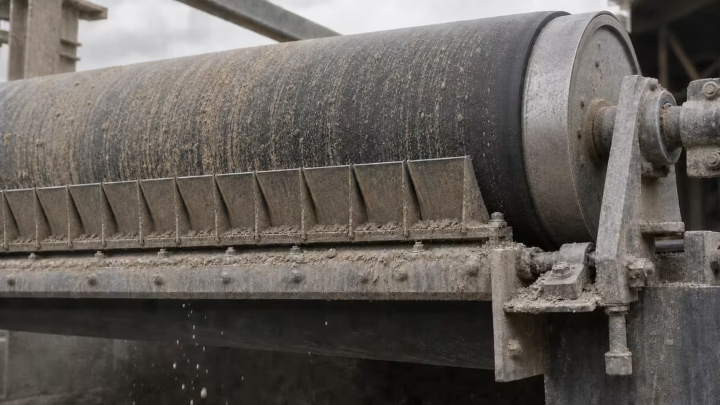
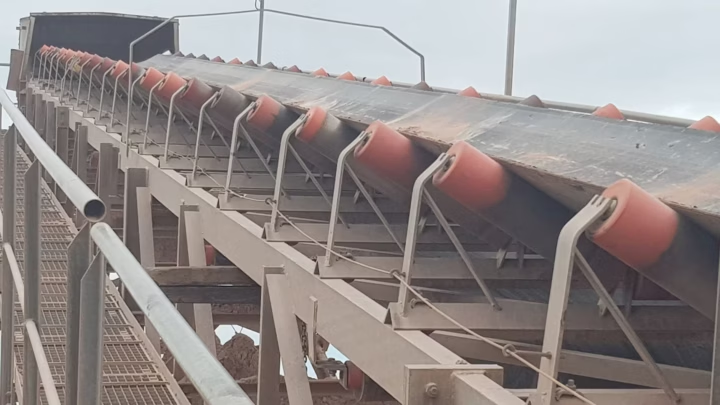
When I walk into a plant I have never seen before, the first place I look is under the belt. Most of the time the picture is the same: crusted return idlers, a cone of fines under the return run, and a shovel leaning against the nearest support, ready to hand. That shovel is the most honest measuring instrument in conveyor technology, because wherever it gets used daily, the scraper has stopped doing its job, or there never was one.

What a conveyor belt scraper really does
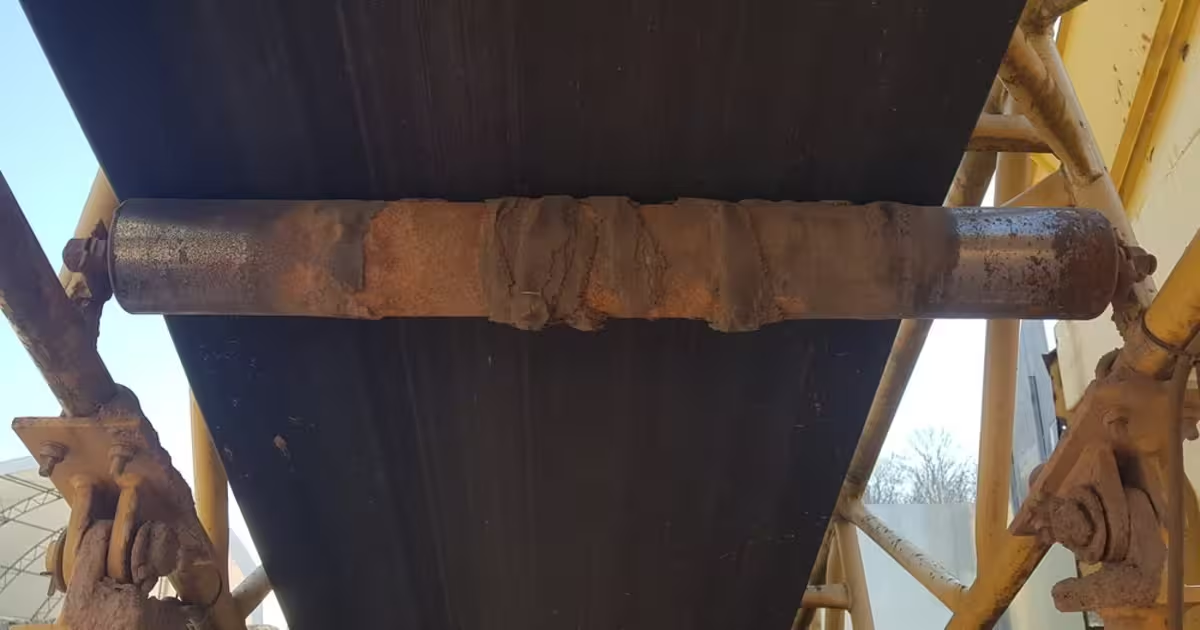
Carryback is the material that does not drop off at the discharge point but stays stuck to the belt and rides back with it. Along the way it settles exactly where nobody wants it: on the return idlers, on the pulleys, in the steelwork and on the floor under the conveyor. The belt picks it up quietly, but on every single revolution.
The consequences are rarely spectacular, but they are relentless. The material cakes onto idlers and pulleys, builds up on one side, and before long the belt runs off track. Manufacturers of cleaning systems list carryback as one of the most common triggers for mistracking and the knock-on wear that follows from it. Then there is the cleaning work itself. A US mining authority, quoted via a manufacturer, puts roughly 100 grams of carryback per square metre as a level you can still live with. Sounds like next to nothing. On a belt 1,200 millimetres wide running at 2 metres per second around the clock, it still comes to around 7 tonnes of material that wants sweeping up from under the conveyor, day after day.
And the idlers? One manufacturer reports on a German opencast lignite mining company that analysed its return idler replacements: around 30 percent traced back to wear from escaped material, not to normal ageing. Three return idlers in ten. Every one of those replacements costs parts, fitter hours and usually belt downtime on top. Scale that up to a full year and you will see why I consider the scraper the most underrated component on the whole conveyor.
The main scraper types at a glance
Scrapers differ mainly in where they sit on the conveyor and how coarsely they are allowed to work. Catalogues call them belt cleaners, belt scrapers or cleaning systems; behind the names is the same principle: an edge or a brush that takes the adhering material off the belt.
| Type | Position | Typical use | What to watch for |
|---|---|---|---|
| Primary scraper (head scraper or pre-cleaner) | Directly at the head pulley, at the discharge point | Coarse first-pass cleaning, ruggedly built, takes the bulk of the carryback | Never manages everything on its own; check the contact pressure regularly |
| Secondary cleaner (fine cleaner) | Behind the head pulley, at the start of the return run | Fine cleaning of the remainder, designed for precision rather than force | Lives on inspection and re-tensioning, otherwise it quietly loses its effect |
| Tertiary cleaner | As a third stage behind the secondary cleaner | Plants with particularly high cleanliness requirements, food or pharmaceuticals for example | Only worthwhile once the first two stages are set up properly |
| Return-belt plough (V-plough) | On the inside of the belt, just ahead of the tail pulley | Clears material away before it gets between belt and pulley | Needs a flat belt surface, according to manufacturer data |
| Brush cleaner | Usually behind the head pulley | Rotating nylon brush for fine, sticky or dusty material such as coal, sugar or transhipment goods | Suppliers recommend it where rigid blades fail on fines |
By the way, when a quotation talks about a PU scraper, that is not a design of its own but the blade material, polyurethane. More on that in a moment, because in day-to-day practice the material question decides between success and aggravation more often than the design does.

Primary or secondary: why one scraper is often one too few
On paper, a primary scraper on its own looks sufficient. Two trade portals arrive independently at similar figures: a primary scraper removes 60 to 80 percent of the initial carryback, or 60 to 70 percent by the more cautious count. Read the other way round, that means 20 to 40 percent rides on. Only the combination with a secondary cleaner lifts the cleaning performance above 90 percent, according to both sources.
No system reaches one hundred percent; neither the belt surface nor the blade edge is anywhere near flawless enough for that. Which is why the same sources recommend a division of labour instead of a single oversized scraper: a rugged pre-cleaner up front, a precise second stage behind it. It is like sweeping up at the end of a shift. The big broom takes the pile, for what is left you need the hand brush.
Whether the second stage pays off is decided by your material. Dry, coarse gravel practically jumps clear at the discharge point on its own. Moist, fine or sticky material hangs on, and that is exactly when the secondary cleaner earns its keep. What carryback costs as a whole system and which cleaning concepts exist beyond blades is a topic that deserves an article of its own.
Blade material: PU, rubber, tungsten carbide, ceramic
One bulk-handling operation I looked after had fitted a tungsten carbide blade on a soft belt. Not out of conviction, but because it happened to be sitting on the shelf, or so I was told there. It cleaned well enough. In the process, it dragged fine grooves into the cover and wore itself down unevenly, because it never sat cleanly on the soft surface. A scraper is meant to clean, not to engrave. The blade material has to suit the belt and the conveyed material, not whatever the storeroom happens to hold.
Polyurethane, PU for short, is the middle ground among blade materials. It is softer than tungsten carbide and wears faster, but it treats the belt gently: a PU blade never gets hard enough to damage the cover if the contact is not right, and over time it moulds itself to the shape of the belt. That is exactly why it is recommended for new belts as much as for older ones with an uneven surface. A repair patch is still a repair patch, though: if it does not sit flush in the cover, even a soft blade finds the edge and tears the patch out sooner or later. Patches with an edge that tapers out to nothing, developed for exactly that, are standard today. For fine, powdery material such as cement or flour, suppliers likewise point to smooth PU blades, because they hug the belt closely.
Tungsten carbide is the other end of the scale. It ranks among the hardest blade materials available, copes with heavy wear and with higher temperatures too, and is the obvious choice for coarse, abrasive material on new, undamaged belts. On a wavy or pre-damaged belt, though, a carbide blade can snag on the irregularities and ruin blade and belt in one go. There are in-between solutions as well: one manufacturer offers carbide-tipped blades on a carrier of polyurethane or rubber which, by its own account, even survive the belt running backwards without damage.
Rubber blades are the flexible and usually cheapest option. Suppliers recommend them for uneven or pre-damaged belt surfaces and for moist, sticky material; in return they wear faster than PU or carbide. Ceramic, finally, comes in where long service life is meant to justify the extra cost.
On service life, one supplier gives a rough orientation for normal conditions: PU 6 to 12 months, tungsten carbide 12 to 24 months, ceramic 18 to 36 months. That is the figure of a single supplier, not a standard, and your plant may sit well above or below it. The same supplier reports a cement works that claims to have stretched the service life of its belt by 40 percent with ceramic secondary cleaners. A single case, but one that points the way. The service lives your own plant has reached so far are more dependable than a catalogue figure.
Contact pressure and adjustment: the most common mistake
The most expensive mistake with scrapers does not cost a cent at purchase: too much pressure. At a sugar factory, the colleague from maintenance gave the head scraper another turn tighter on every walk-round, on the logic that more pressure means a cleaner belt. After a few weeks the cover looked as if someone had gone over it with coarse sandpaper: long grooves, drawn cleanly in the running direction. We backed the pressure well off. The cleaning got better, not worse, and the belt finally got some peace.
Behind this sits a simple relationship: there is an optimum range for contact pressure, and cleaning performance falls away in both directions from it. Too much pressure raises the friction between blade and belt. The blade wears faster, the cover suffers, the drive draws more energy, and the belt does not get any cleaner for it. With tyre pressure, everyone accepts that there is a correct range and that any deviation costs money. The same holds for the scraper, except the target value is not printed on a sticker in the door frame.
Too little pressure is just as treacherous, and that surprises many people: the blade then cleans worse yet wears faster at the same time. Material gets pulled through the gap between blade and belt at belt speed and mills fine grooves into the edge. Those grooves widen until the edge is downright frayed. You can spot an edge like that at a glance during a visual inspection, once you know what you are looking for.
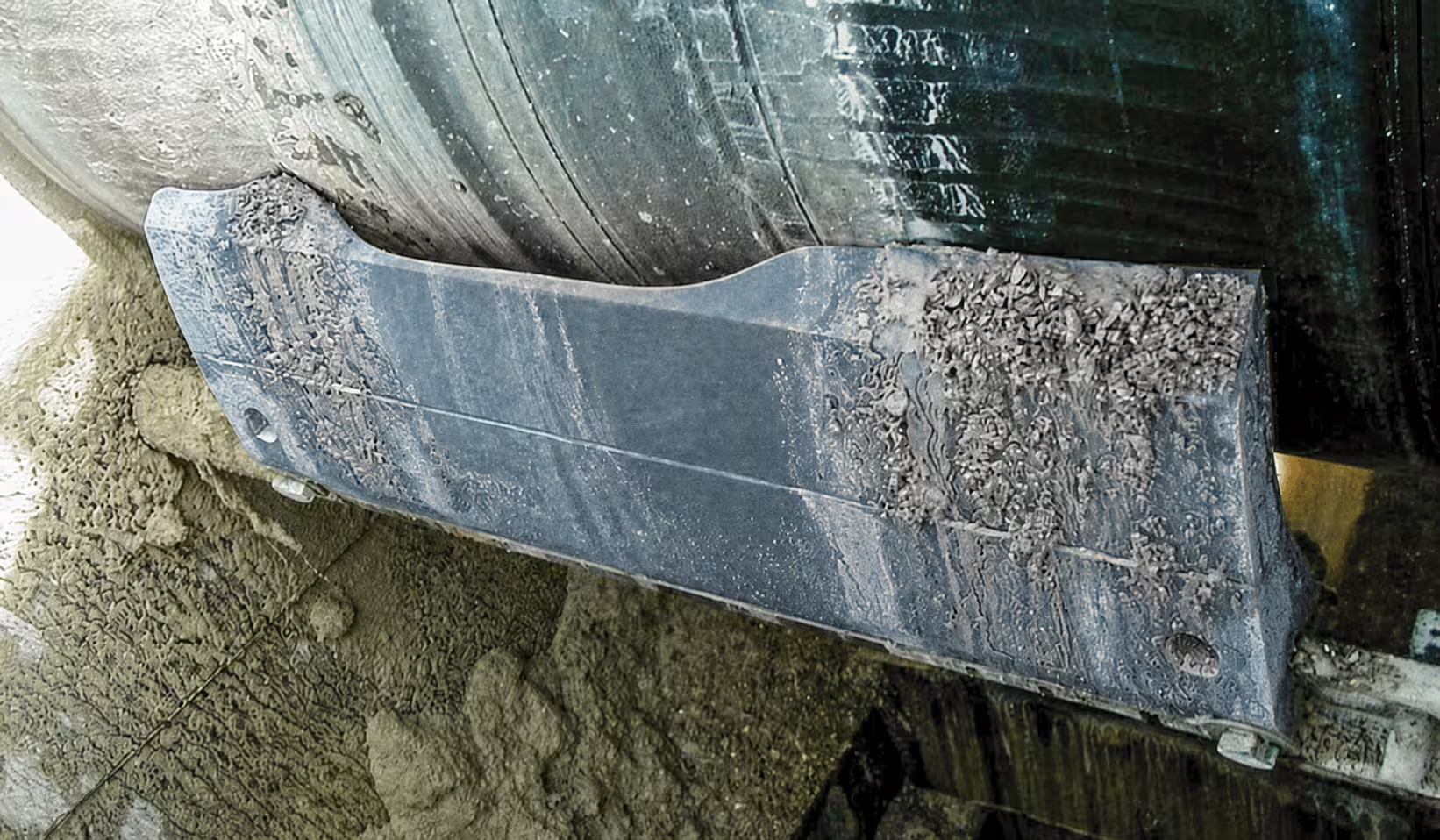
On top of that comes a creeping effect: as a PU blade wears, its contact area with the belt grows. The pressure per unit of area drops, even though nobody has touched the tensioner. Mechanically tensioned systems therefore need regular re-tensioning, otherwise even a well-chosen system cleans only half-heartedly after a few months. Manufacturers regard missed re-tensioning as the main reason why otherwise suitable scrapers disappoint in service; good tensioners can be adjusted without tools for exactly that reason. You will find no concrete pressure figures here, and that is deliberate: generally valid, documented values do not exist, and the right range depends on the system and its manufacturer.
Typical wear signs: when the blade is due
A scraper shows its wear long before it fails completely. You just have to know where to look. The three most reliable signs: more carryback than usual under the belt, fresh spillage around the head pulley, and a blade edge that is visibly or unevenly worn.
During the visual inspection, the first look belongs to the blade edge, because that is where wear shows first. The second look goes to the running conveyor: does the blade still sit against the belt along its whole length? Do stripes of material stay behind on the belt after the scraper? A worn blade works like an old windscreen wiper. It has stopped wiping, it just smears.
Suppliers recommend making blades, mountings and the tensioning mechanism a fixed part of the regular visual inspection, and watching the conveyor in a test run after every adjustment. Fixed replacement dates by calendar, on the other hand, have never worked for me: a blade wears by operating hours and material, not by date. How much reserve can sit in a blade is shown by a single case study with condition monitoring: there, a vibration sensor reported the state of the secondary cleaners, and the operator was able to stretch the blade change from 25 to 30 days out to 40 to 45 days without the cleaning getting any worse. One single plant, not a standard. But a hint at what watching the condition is worth compared with guessing.
Anything that makes the swap quick is useful too. Some suppliers deliver systems with tool-free blade change (pull the pin, swap the blade, set the pin) and special blades for hot, chemically aggressive or heavily abrasive environments. If the change takes ten minutes instead of two hours, it actually gets done.
The scraper as a spare part: what your supplier needs to know
At some point, despite all the care, a new purchase is due, and then the quality of your enquiry decides the quality of the quotation. What follows is field experience from many spare-part enquiries, not a standard. A supplier who knows the following points can offer you a system that fits instead of the nearest catalogue match:
- belt width and, if known, belt speed
- conveyed material with its properties: dry, moist, sticky, abrasive, sharp-edged
- installation point: head pulley, the underside of the belt or ahead of the tail pulley
- the existing scraper type and, if available, the model
- photos of the scraper and of the installation area
- operating environment: wet, dusty, hot, oily or with food contact
- the result you want: coarse cleaning, fine cleaning, protection of the return side or less spillage
The photos matter more than most people think. A picture of the installation space answers questions nobody thinks to ask on the phone: how much room is there under the pulley? How does the fitter get at the tensioner? And the cleaning goal belongs in the enquiry because it steers the choice of system. Someone whose main aim is to protect the tail pulley needs something different from someone who has to hand the belt over broom-clean to the next transfer point. This is craft, and it starts with a complete enquiry.
- Carryback is material that stays on the belt after the discharge point. It ends up on idlers, pulleys and under the conveyor, and it causes cleaning work, idler wear and mistracking.
- A primary scraper on its own removes 60 to 80 percent of the carryback, depending on the source. Only with a secondary cleaner does the system get above 90 percent, and none reaches 100.
- The return-belt plough (V-plough) protects the inside of the belt and the tail pulley; the brush cleaner helps with fine, sticky material.
- Choose the blade material to match belt and material: PU is gentle on the belt, tungsten carbide lasts longer than PU and rubber on intact belts, rubber forgives uneven surfaces.
- Contact pressure has an optimum range. More pressure does not clean better, and without regular re-tensioning every system falls off.
- Change the blade on wear signs (more carryback, spillage, a frayed blade edge), not by calendar.
Frequently asked questions
How often should a conveyor belt scraper be replaced?
By condition, not by fixed interval. The reliable triggers are more carryback than usual, spillage at the head pulley and a visibly or unevenly worn blade edge. As a very rough orientation, one supplier quotes 6 to 12 months for PU blades under normal conditions, 12 to 24 months for tungsten carbide and 18 to 36 months for ceramic; those are supplier figures, not a standard.
What is the difference between a head scraper and a V-plough?
The head scraper sits on the outside at the head pulley and cleans the carrying side of the belt right at the discharge point. The return-belt plough, usually a V-shaped design, sits on the inside of the belt just ahead of the tail pulley and clears material away before it gets between belt and pulley and causes damage there.
When do you need a secondary belt cleaner?
Whenever the primary scraper alone is not enough: with moist, fine or sticky material and at high throughput. A primary scraper lets 20 to 40 percent of the carryback through; only the combination of both stages lifts the cleaning performance above 90 percent, and no system reaches 100.
Are polyurethane scraper blades better than rubber or tungsten carbide?
There is no material that is better across the board, only one that fits better. PU is gentle on the belt and adapts to uneven surfaces, tungsten carbide lasts longer than PU and rubber on new, intact belts carrying coarse, abrasive material, and rubber is the flexible, low-cost choice for moist or sticky material. Belt condition and conveyed material give the answer, not the catalogue.
Can a badly adjusted scraper damage the conveyor belt?
Yes. Too much contact pressure raises the friction, wears blade and cover prematurely and drives up energy consumption. Too little pressure lets material shoot through between blade and belt, which mills grooves into the blade edge and makes the cleaning worse still. That is why the adjustment belongs in the regular maintenance routine.
The Conveyor Belt Calculator gives you cross-section, belt speed and drive power, free in the browser and without signing up.