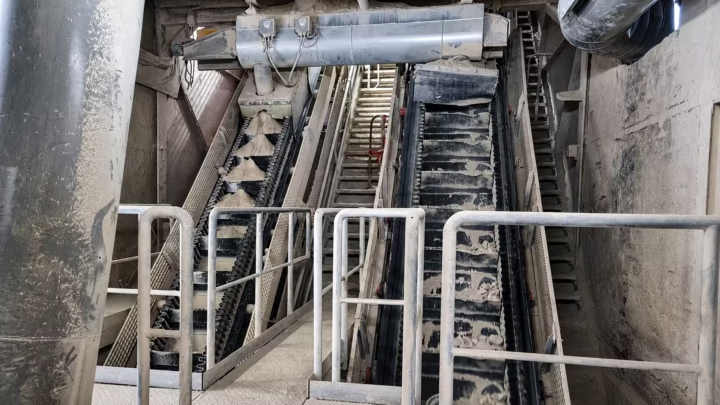
The buyer at a coal-fired power plant I looked after for years ordered the new belt to match the old one. Same width, same strength, and he read straight past the letters at the end of the designation. To him they were just a number with a couple of codes tacked on at the end. The new belt looked like the old one, but at the loading point it lasted noticeably less time, because the carrying side came out thinner and the cover was a different grade.

Why the marking decides months of service life
The marking on a conveyor belt is something most people skim. But it decides how long the belt lasts, and at the start nobody can see it coming.
Yet that string of characters holds everything that matters. It names the carcass, the strength, the number of fabric plies and, this is the point here, how thick the two covers are and what grade they are made of. The carrying side and the pulley side are given separately, for instance as a pair of numbers like 4 plus 2. A millimetre or two less on the carrying side sounds like nothing. At a loading point, where the material lands day after day, it is the difference between a belt that lasts a season and one that does not.
That is what happened to the buyer at the start. He reordered by the look of the belt, not by the designation, and the look gives nothing away about the cover grade. A conveyor belt is not something you reorder on a hunch. It is often one of the most expensive single parts on the whole plant, and if you buy it on the wrong criterion, you pay for the mistake over its service life. The good news: the designation is readable, once you know what the marks stand for. That is what we will now work through.
The cover: the protective layer over the carcass
At its core a conveyor belt is two things. Inside sits the carcass, the tension member that takes the load and carries the belt. Whether that is textile fabric plies or steel cords is a story of its own. Outside sits the cover, a rubber layer on the carrying side and the pulley side. It carries no load. It fends off whatever acts on the belt.
It pays to keep the two apart, because the two properties have nothing to do with each other. The strength tells you how much tension the belt can stand. The cover grade tells you how well it copes with the conveyed material, that is with abrasion, with impact, with cuts. A belt can be strong enough and still be the wrong build, if the cover does not match the material. In the calculation the design then checks out. In service the carrying side grinds away, long before the carcass fatigues.
That is why the designation codes the two separately, and why the cover grade is worth a look even when the strength and the ply count have long been settled. The cover is the layer where you will later read off the wear, and the grade is your advance decision on how fast that happens.
DIN abrasion grades: W, X, Y, Z and what they measure
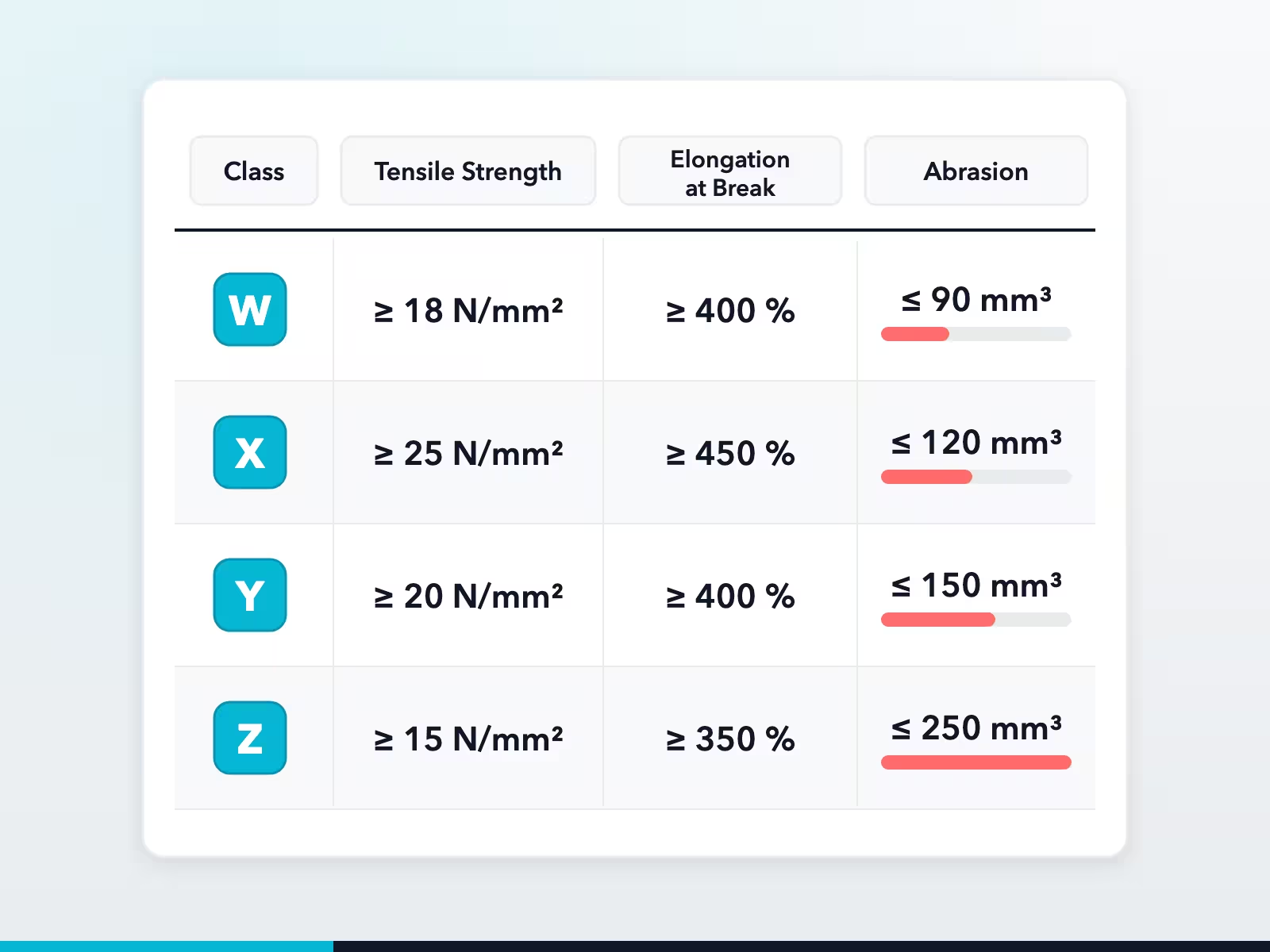
The classic system in the German-speaking world is DIN 22102. It tests the cover on three values: the tensile strength in megapascals, the elongation at break in percent, and the abrasion loss in cubic millimetres. The last value is the most important one for service life, and it is also the one people most easily read the wrong way round.
With abrasion loss it works like fuel consumption: the smaller number is the better one. A figure of 90 cubic millimetres means the abrasion test wore away only a little rubber. So that belt is more abrasion-resistant than one at 250. Read the figure the other way round and you reach for the wrong grade every time.
| Grade | Min. tensile strength | Min. elongation at break | Max. abrasion loss | What it is meant for |
|---|---|---|---|---|
| DIN W | 18 MPa | 400 % | 90 mm³ | fine, sanding abrasion, best abrasion value |
| DIN X | 25 MPa | 450 % | 120 mm³ | coarse, sharp-edged, hard-striking lumps |
| DIN Y | 20 MPa | 400 % | 150 mm³ | normal operating conditions, the all-rounder |
| DIN Z | 15 MPa | 350 % | 250 mm³ | simple, economical grade |
One look at the table already shows the trap. Y is the standard for normal conditions and a good starting point when nothing argues against it. W has the best abrasion value at 90 cubic millimetres, but on tensile strength it is weaker than X. And X, while it carries a higher, and therefore worse, abrasion value than W, has the highest tensile strength and elongation at break of the lot. That crossover is deliberate and has a practical reason, which the next section explains.
W or X: two different kinds of wear
This is the crux of the whole subject, and I learned the same lesson at a sand pit and at an open-pit ore mine. Both had bought the same belt, both pointed to the word abrasion-resistant in the brochure, and yet the service lives came out completely different.
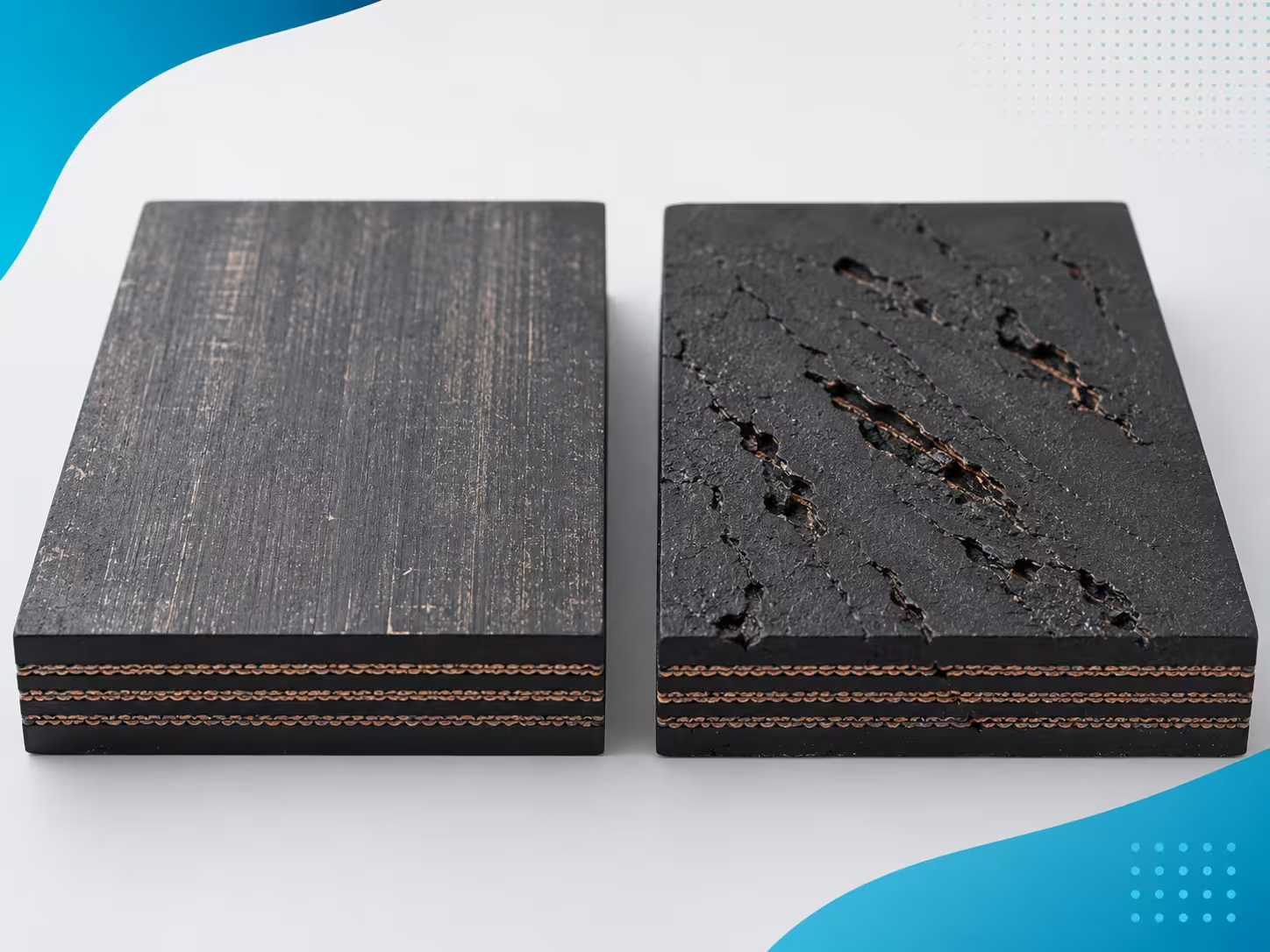
The first operation conveyed fine, hard sand. It acts like sandpaper and wears the cover down evenly across the surface, revolution after revolution, quiet and steady. The second had coarse, sharp-edged lumps in the material stream. Those do not sand, they cut. They tear notches and cuts into the surface, and a belt built only for low abrasion offers little resistance to them. The same belt was right for the one and wrong for the other, because two different wear mechanisms were at work.
That is exactly what W and X separate. W brings the best abrasion value and is therefore the choice for fine, sanding material. X brings the highest tensile strength and elongation at break and shrugs off cuts, impacts and gouges better. The higher abrasion value of X is simply the wrong figure for this kind of load. With coarse lumps it is not abrasion that ends a belt’s service life, but the cut.
The mistake costs twice. Once when you put the best abrasion grade up against sharp lumps and it fails at the notches, even though the abrasion value looked good on the data sheet. And once the other way round, when you reach for a more expensive grade whose strength you do not need at all for your fine material. Look only at the price, or only at the word abrasion-resistant, and you will likely be addressing the wrong kind of wear. How cover wear shows up in detail on a running belt and what you can do about it is covered in a separate article.
DIN, ISO and RMA: the same thing in three languages
Compare data sheets from different sources and you trip over three grading systems that mean the same thing and write it differently. It is like metres, feet and yards. Different measuring systems for the same distance, and all you have to know is how to convert between them.
Alongside the classic DIN 22102 with W, X and Y there is the international EN ISO 14890, which labels the same cover types H, D and L. By manufacturer mapping, DIN X corresponds roughly to ISO H, DIN W roughly to ISO D and DIN Y roughly to ISO L. I am leaving out the separate numerical values of the ISO grades here on purpose, because only the letter mapping could be pinned down cleanly, not their own cubic-millimetre limits. As the numerical anchor, the DIN values from the table above still stand.
From the US comes the RMA system, today under its successor ARPM. Two levels again, with the emphasis swapped: RMA Grade I, at 17 megapascals and no more than 150 cubic millimetres, stands for cut and gouge, so it is the counterpart to DIN X. RMA Grade II, at 14 megapascals and no more than 200 cubic millimetres, emphasises abrasion for fines and sits closer to DIN W. The successor grades ARPM Grade 1 and Grade 2 draw the abrasion limits a little tighter, at no more than 125 and 175 cubic millimetres respectively.
| DIN 22102 | EN ISO 14890 | RMA / ARPM (US) | What the grade targets |
|---|---|---|---|
| X | H | Grade I / Grade 1 | cut and gouge, coarse lumps |
| W | D | Grade II / Grade 2 | abrasion, hard fines |
| Y | L | Standard | normal operating conditions |
One subtlety is worth real money in daily practice: the source notes that DIN tends to measure abrasion more strictly and is more widely recognised worldwide. So when you have a quote with a US grade next to one with a DIN grade, do not compare only the letters, compare the cubic millimetres. Otherwise you buy two belts that sound identical on paper and last for different lengths of time in service.
Special properties: oil-, heat-, flame- and cold-resistant
Abrasion is not the only demand a cover has to withstand. Once oil comes into play, or heat, frost or fire risk, the abrasion grade on its own is no longer enough, and the marking adds another letter. These extra letters stand for special cover grades:
- G for oil- and grease-resistant
- T for heat- and high-temperature-resistant
- R for cold-resistant at low temperatures
- K and S for flame-retardant and self-extinguishing
- E for antistatic
- C for chemical-resistant
Here I have to be honest, and so is the source. The actual limit values behind these letters are not consistently standardised. How hot a T type may run continuously, or which oils a G type really resists, is not fixed as a number in a standard; according to a neutral trade reference, it is a matter to be agreed between user and manufacturer. So you will find no temperature or oil limits here in degrees or percent, and that is on purpose. If you need a special cover, give the supplier your medium, your temperature and your operating hours, and have the right version confirmed. Get the limit values in writing.
A word on thrift: every special property has its price, and often a side effect on another property too. A heat-resistant compound behaves differently under abrasion than a pure abrasion compound. The special property that makes sense is the one the operation actually calls for.
Reading a belt designation: EP 500/3 4+2 X decoded
Now we put the parts together. A typical designation looks like this: EP 500/3 4+2 X. At first glance a jumble of codes, in truth a sentence with five statements that you read from left to right.
| Part | Meaning |
|---|---|
| EP | Textile carcass, polyester lengthwise and polyamide across |
| 500 | Nominal strength of the whole belt, 500 newtons per millimetre of belt width |
| 3 | Number of fabric plies |
| 4+2 | Covers: 4 mm on the carrying side, 2 mm on the pulley side |
| X | Abrasion grade of the cover, here cut- and gouge-resistant |
Two spots mislead people again and again. The 500 is the nominal strength of the whole belt in newtons per millimetre of width, not per ply. Some manufacturer pages word this ambiguously, but the correct reading under the standard applies the figure to the whole belt. And the pair of numbers 4 plus 2 is the detail the buyer at the start read straight past. It states to the millimetre how much rubber sits on each side. The bigger of the two numbers goes on the carrying side, where the material rests and rubs, the thinner one on the pulley side, which runs over the pulleys.
With that you can read a designation in full. Two belts with the same strength and the same ply count are simply not the same when one reads 4 plus 2 and the other a thinner pair, or when one carries an X and the other a Y. This is a matter of reading, and it spares you the mistake at the next reorder, the one that costs months of service life.

- The cover is the wear layer over the carcass. Its grade is to be judged separately from the strength, and it appears separately in the marking.
- The DIN 22102 abrasion grades are W, X, Y, Z. Abrasion loss is measured in cubic millimetres, and the smaller number is the more abrasion-resistant one.
- W and X separate two kinds of wear: W is for fine, sanding abrasion, X for coarse, cutting lumps. The grade follows the wear pattern, not the word abrasion-resistant.
- DIN, ISO 14890 and RMA are the same thing in three languages: DIN X corresponds roughly to ISO H, W to D, Y to L. When comparing, look at the cubic millimetres, not just the letters.
- Extra letters such as G, T, R, K, S, E, C stand for oil-, heat-, cold-, flame- and chemical-resistant and antistatic versions. Their limit values are to be agreed with the manufacturer.
- A designation like EP 500/3 4+2 X reads from left to right: carcass, strength of the whole belt, plies, cover thicknesses, carrying side plus pulley side, abrasion grade.
Frequently asked questions
What do the letters W, X, Y and Z mean on a conveyor belt?
They stand for the abrasion grade of the cover under DIN 22102. Y is the standard for normal conditions, W has the best abrasion value for fine, sanding material, X, with the highest tensile strength, is meant for coarse, sharp-edged lumps, and Z is the simple, economical grade with the highest permitted abrasion. Among the things measured is the abrasion loss in cubic millimetres, where the smaller number is the better one.
Is DIN X or DIN W more abrasion-resistant?
On pure abrasion, W is more abrasion-resistant. At 90 cubic millimetres it has the lowest permitted abrasion loss, while X sits above it at 120 cubic millimetres. On the other hand X is more cut- and gouge-resistant, because it brings the highest tensile strength and elongation at break. So for fine material you tend towards W, for coarse lumps that strike hard, towards X.
How do DIN and ISO 14890 line up?
Both describe the same cover types with different letters. By manufacturer mapping, DIN X corresponds roughly to ISO H, DIN W roughly to ISO D and DIN Y roughly to ISO L. The letter mapping is documented; the DIN values serve as the numerical anchor, because the ISO grades’ own cubic-millimetre limits could not be confirmed cleanly.
What do oil-resistant and heat-resistant mean for the cover?
Extra letters flag it: G stands for oil- and grease-resistant, T for heat- and high-temperature-resistant. The actual limit values, meaning which temperature or which oil the cover can take, are not consistently standardised but are to be agreed between user and manufacturer. Give the supplier your medium, temperature and operating hours, and have the resistance confirmed.
How do I read a designation like EP 500/3 4+2 X?
From left to right. EP is the textile carcass of polyester and polyamide, 500 the nominal strength of the whole belt in newtons per millimetre of width, the 3 the number of fabric plies, 4+2 the cover thicknesses with 4 mm on the carrying side and 2 mm on the pulley side, and X the abrasion grade. With that you can tell at a glance whether two belts really are the same.
The Conveyor Belt Calculator delivers cross-section, drive power and a belt recommendation, free in the browser and without signing up.